Blog
DSTL boosts robotic navigational testing for CBR threat

The focus was on chemical, biological or radiological (CBR) substances that can threaten public health, especially in confined spaces. For example, shopping centres.
In a ‘real life’ scenario played out in an empty shopping unit, the Defence Science and Technology Laboratory (Dstl) tested the ability of robotic and autonomous systems to navigate through a building and detect, sample and remediate (clean) a contaminated environment.
DSTL
The research organisation highlighted that urban interior spaces pose a number of challenges.
These include low-level lighting, repeating and uneven walls and ceilings, and other high or difficult to reach surfaces. For example, drones can struggle with interior airflows and navigation between walls of the same colour.
Navigational testing
The trial – funded by the Department for Environment, Food and Rural Affairs (Defra) – featured autonomous unmanned vehicles, both ground-based or air-based systems.
Basically, the idea is to enable navigational testing in more realistic scenarios. This in turn will lessen the need to put people into hazardous environments, whether chemical, biological or radiological. And use robotics instead, “forward of the hot line”.
Partners
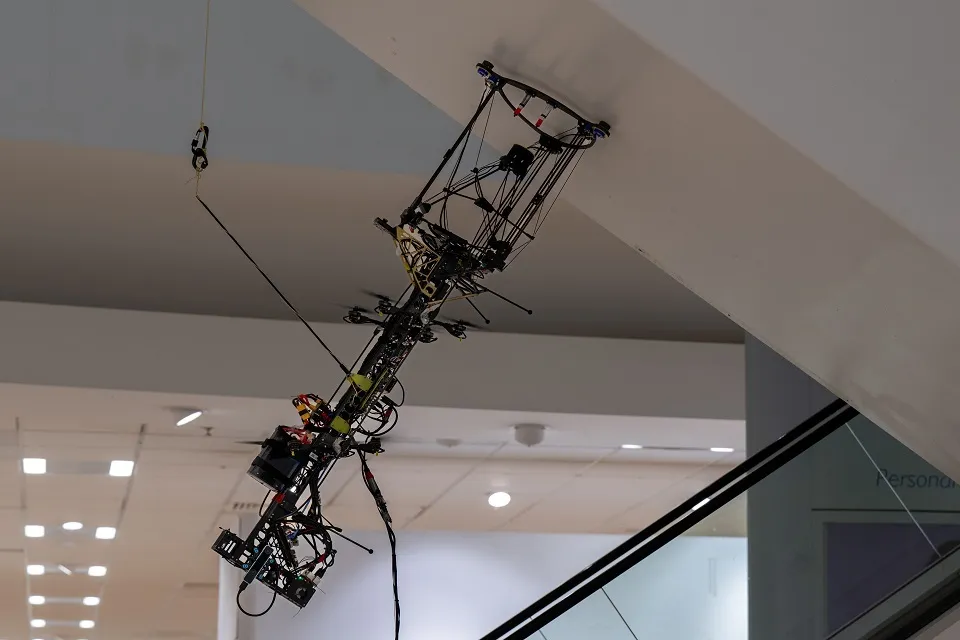
Dstl worked with a range of academic and industrial partners deploying specialist equipment in the trial. This included Createc, which develops robotics software, and the University of Bristol. The latter is pioneering an uncrewed ground vehicle with a robotic arm that will work with a tethered drone (pictured above) to carry out decontamination with a spray system at a range of heights.
“This trial has allowed us to bridge the gap between research and the operational environment,” said Ian Wilding, technical lead. “Dstl has expertise in operational analysis, uncrewed vehicles and autonomy. We bring all these together to deliver cutting-edge science to improve UK resilience.”
Defra
Defra is the UK government department responsible for “environmental remediation” following a contamination event.
It is partnering with Dstl to establish a National Technical Advisory Group for CBR Recovery (NTAG-R). The aim is to provide authoritative technical advice on the requirements for CBR recovery operations.
See also: DSTL runs Nato compo for youth perspective on disruptive technologies