Blog
NVIDIA Develops 2-3x Faster Real-Time Path Tracing with Better Image Quality

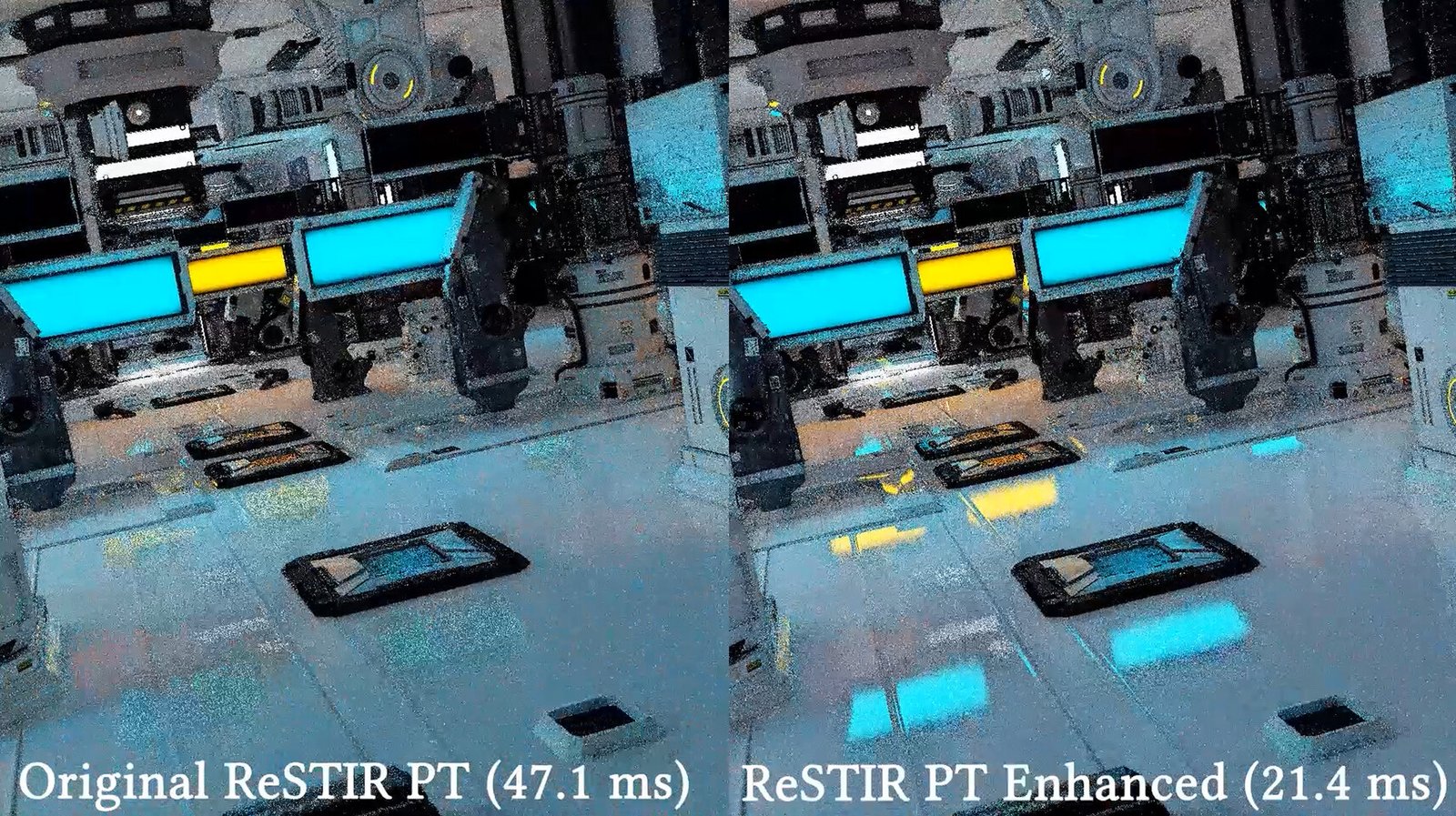
NVIDAAlgorithms leveraging ReSTIR-style spatiotemporal reuse have recently proliferated, hugely increasing effective sample count for light transport in real-time ray and path tracers. Many papers have explored novel theoretical improvements, but algorithmic improvements and engineering insights toward optimal implementation have largely been neglected. We demonstrate enhancements to ReSTIR PT that make it 2-3x faster, decrease both visual and numerical error, and improve its robustness, making it closer to production-ready. We halve the spatial reuse cost by reciprocal neighbor selection, robustify shift mappings with new footprint-based reconnection criteria, and reduce spatiotemporal correlation with duplication maps. We further improve both performance and quality by extensive optimization, unifying direct and global illumination into the same reservoirs, and utilizing existing techniques for color noise and disocclusion noise reduction.
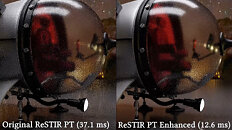
Users can check out the NVIDIA video demonstration through the link provided here. As one Redditor noted, Dynamic Diffuse Global Illumination (DDGI) in 2019 helped bring real-time global illumination to more games and even current consoles by making dynamic lighting much more affordable. Reservoir-based Spatiotemporal Importance Resampling (ReSTIR) in 2020 was a significant advancement because it made real-time path tracing much more practical by reusing effective light samples instead of recalculating everything from scratch. Now, Reservoir-based Spatiotemporal Importance Resampling for Path Tracing Enhanced (ReSTIR PT Enhanced) in 2026 is expected to push things even further by making path-traced direct lighting and global illumination more accessible to developers. This could enable future games to achieve higher visual quality without requiring extremely powerful hardware.