Blog
AMD Details Upcoming Zen 6 PQOS Extensions: Advanced Bandwidth and Privilege Controls

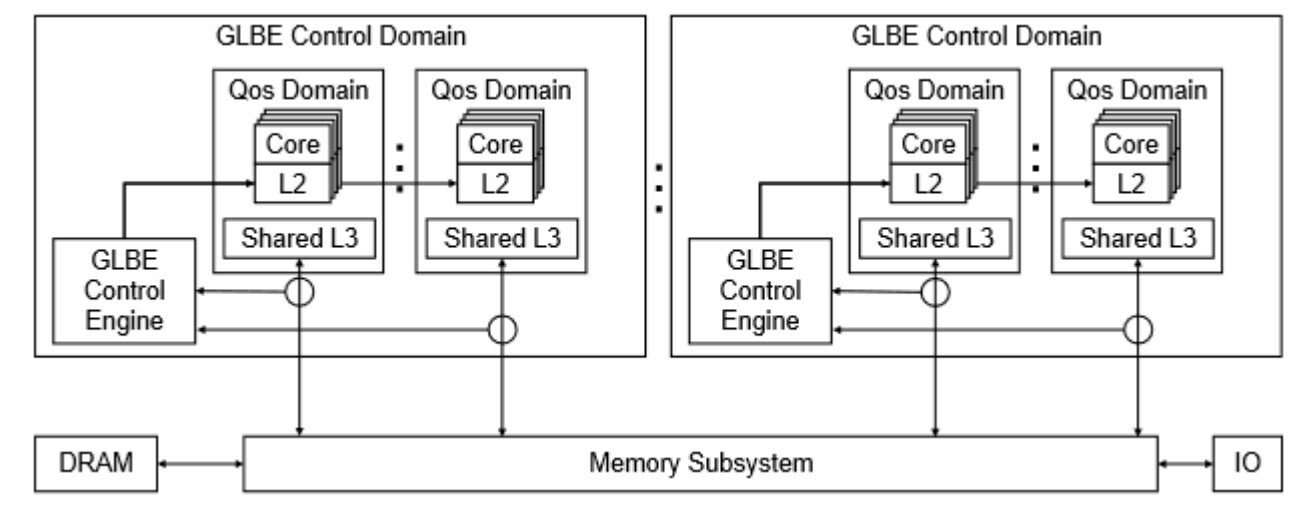
A highlight of the Zen 6 PQOS updates is the implementation of Global Bandwidth Enforcement (GLBE), which allows system software to specify L3 external bandwidth limits for groups of cores that span across multiple traditional QoS Domains. By grouping these into a unified “GLBE Control Domain,” AMD enables a competitively shared bandwidth ceiling for specific Classes of Service (CoS). This upgrades older architectures that only provided L3 external bandwidth enforcement on a strictly per-domain granularity. Next up, AMD introduced Global Slow Bandwidth Enforcement (GLSBE), a parallel feature that applies the exact same multi-domain bandwidth limiting principles to system memory explicitly designated as “Slow Memory.” Both GLBE and GLSBE provide granular controls via specific model-specific registers.
Rounding out the Zen 6 microarchitecture updates is Privilege-Level Zero Association (PLZA), a unique performance and security monitoring feature that grants hardware the ability to automatically associate highly privileged execution with a specific CoS or Resource Monitoring Identifier (RMID). Historically, AMD PQOS mechanisms tied these identifiers to each logical processor on a standard per-thread basis. PLZA, however, empowers the system to actively override this thread-level association whenever a logical processor executes at Privilege Level Zero (CPL=0). This ensures that system software, such as the host OS kernel or a hypervisor running with AMD SVM enabled can utilize tailored resource limits regardless of the thread’s standard user-level configuration.