Blog
Nato chief says Europe increased defence spending by 20% in 2025 – Europe live | World news

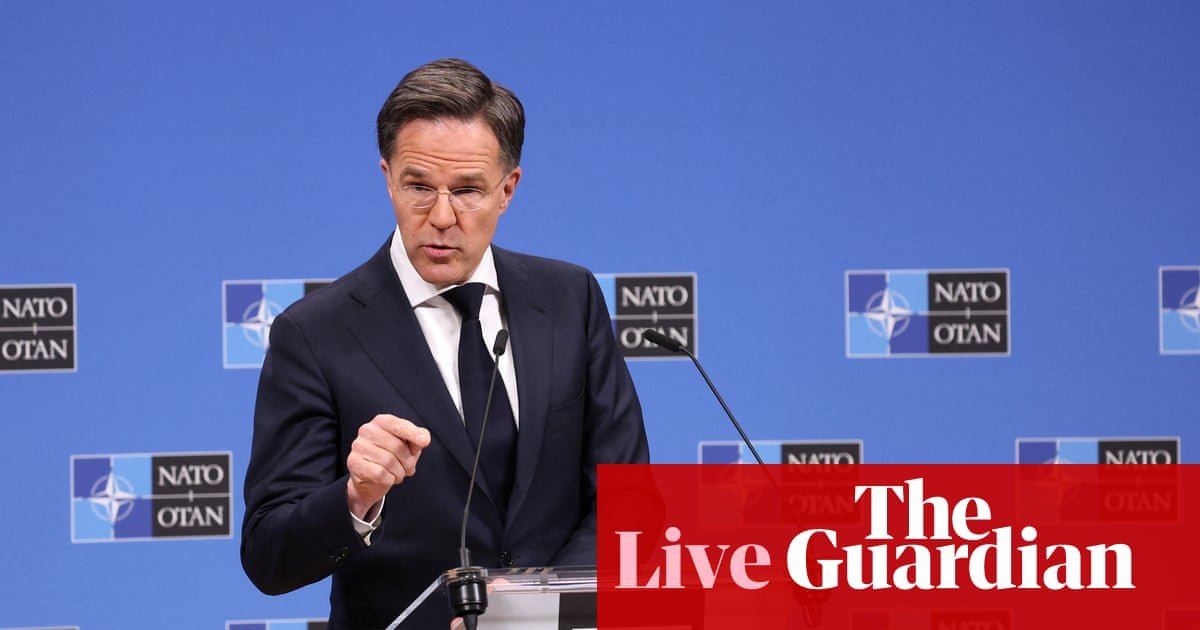
Nato chief says Europe increased defence spending by 20% in 2025
Nato’s Rutte says that on the back of the 2025 summit in the Hague, allies “took a historic decision to raise defence investment to 5% GDP,” with “significant progress” over the course of the year.
“For the first time, all allies met the goal agreed in 2014 to invest at least 2% of their GDP on defence,” he adds.
He notes that “we saw 20% increase in what Europe and Canada spent on defence in 2025 as compared with 2024.”
“Continuing this crucial trend will be a priority in the years to come,” he says.
He continues:
“For too long, European allies and Canada were overreliant on US military might. We did not take enough responsibility for our own security.
But there has been a real shift in mindset, a collective recognition of our changed security environment. And as a European, I am proud of what we are doing.”
Key events
Hungary files espionage charges against top investigative journalist over claims about minister’s phone calls with Russia
‘Russia remains most significant, dire threat,’ Rutte says
Nato chief says Europe increased defence spending by 20% in 2025
Nato’s Rutte presents alliance’s 2025 annual report
EU accuses four pornographic platforms of breaking digital rules aimed to protect children
European Parliament advances EU-US trade deal, but adds safeguards – snap analysis
Money from oil and gas means Russia has more time for war against Ukraine, Zelenskyy says
Zelenskyy warns about risks posed by ‘aggressive Russian regime’
‘Whatever Putin may tell himself, Russia is not winning’ in Ukraine, Starmer says
Threat from Russia ‘has not gone away; in fact, has grown,’ Starmer warns
European Parliament votes to advance EU-US tariff deal
US ‘needs nothing’ from Nato and will ‘never forget’ its lack of help on Iran, Trump says
Russia wants to ‘continue war, try to conquer as much as possible,’ Lithuania’s Nausėda warns
More interventions against Russian shadow fleet expected in coming weeks and months, Dutch PM says
‘Politeness will not work with Russia,’ Estonia’s Michal says
Europe will keep asking US to play role in Ukraine talks, Norway’s Støre says
Latvia’s Siliņa urges Europe to ramp up drone production
‘What Russia is doing is very concerning,’ Sweden’s PM warns
Proposed safeguards needed to guarantee certainty from ‘relatively one-sided’ deal, senior lawmaker says
Morning opening: EU parliament set to vote on tariff deal with US
Rutte also repeatedly gets asked about the recent Iranian attempt to strike the US-UK base on Diego Garcia, which he acknowledges as a “relevant development” showing Iran’s capabilities.
He insists Nato is “prepared” and can defend itself, pointing to three interceptions of missiles heading for Turkey.
And that ends his briefing.
The full 2025 annual report is here, if you would like to read it too.
Rutte gets once again asked about Trump’s criticism of Nato as “cowards.”
And he once again responds by praising Trump (13:19).
Back to Brussels, Rutte says that despite significant ramping up of defence spending, there are still areas that require improvements.
“The defence industrial base at the moment is simply not producing enough, and we are not fast enough in implementing innovation. We are getting better, but we have to do more,” he says.
In other passage, he says that despite the world’s attention shifting to the Middle East, the essential equipment continues to flow to Ukraine, as does the supply of equipment purchased under the alliance’s Prioritised Ukraine Requirements List, or PURL.
Hungary files espionage charges against top investigative journalist over claims about minister’s phone calls with Russia
Flora Garamvolgyi
in Budapest
The Hungarian government is filing charges against Hungary’s leading investigative journalist, Szabolcs Panyi, for alleged espionage amid the fallout from media reports claiming Hungary’s foreign minister regularly consulted with Russia.
Orbán’s chief of staff, Gergely Gulyás, confirmed at Thursday’s press briefing that Hungary’s justice minister Bence Tuzson decided to file charges against Panyi.
Gulyás said “the details already known to the public were sufficient enough” to press ahead, alleging Panyi had “spied against his own country in cooperation with a foreign state.”
A Washington Post piece last week alleged that Hungary’s foreign minister, Péter Szijjártó, frequently updated his Russian counterpart on the phone with the details of confidential EU meetings.
The Guardian has independently confirmed that Szijjártó shared confidential information with Lavrov.
After the Post’s article, a pro-government online publication, Mandiner, published an article claiming that foreign intelligence agencies had wiretapped Szijjártó with the help of Panyi.
The piece included an edited audio recording of Panyi talking to an unidentified woman, in which he spoke about sharing Szijjártó’s phone number with a source at an EU government agency.
According to Gulyás, it is “not considered investigative journalism” when someone “gives a minister’s phone number to a foreign intelligence service,” alleging the journalist’s intent had been to have the minister’s phone wiretapped. “That’s espionage,” Gulyás added.
After Gulyas’s statement, Panyi published a Facebook post denying the espionage allegations and saying the recording was heavily edited.
Panyi is understood to be working on a book on the Russian interference in Hungarian politics. He was previously targeted with the Israeli spyware Pegasus on numerous occasions.
Jakub Krupa
But there is a bit of an update from Hungary on that very issue.
Let’s go over to Flora Garamvolgyi in Budapest.
Nato’s Rutte also got asked about media reports alleging Hungary’s foreign minister Péter Szijjártó regularly exchanged information with third countries, including Russia’s foreign minister Sergei Lavrov.
He sidesteps the issue saying that “all 32 allies agree that Russia is our most significant threat,” and not really addressing the original question.
In the Q&A, Rutte also gets some questions on the situation in the Middle East.
Among others, he gets asked about reports that Russia supplies Iran with combat drones.
He says he cannot really comment on this as it would risk compromising intelligence sources, but added that he was not “naive” about it, adding “we have known this for some years that there is a close connection between Iran, Russia, North Korea and China.”
In the Q&A, Rutte repeatedly gets asked about Trump, and his criticism of Nato allies as “cowards” and his repeated claims that the US would “remember” their refusal to help on Iran.
As ever, he is very careful not to criticise the US president.
He says instead:
“What I have been seeing is some frustration … about the Europeans needing to take time to react to his requests … and I said, hey, there is a reason for that. … For good reasons, the US was not able to consult with allies because they wanted to keep the campaign, secret again, for good reasons, to make sure that, nobody knew what happened on that Saturday morning.”
But he says that numerous Europeans are now willing to “come together to discuss” what they can do to help with keeping the strait of Hormuz open.
Straight away, Rutte gets a question on the US and its relation with Nato – and he jumps right in to praise Trump.
He insists in response that, without Trump, the alliance would not have been in the current position of reaching 2% at the end of 2025.
“Without the present administration in the United States and the present president, I don’t think you would ever have reached this commitment to spend 5% of our GDP on defence, including the 3.5% on core defence [either],” he says.
He also pointedly praises “Trump 47” as he refers to him (!?) for opening the dialogue with Russia and “breaking the deadlock,” even thought the negotiations do not appear to be progressing at the moment.
‘Russia remains most significant, dire threat,’ Rutte says
Rutte says that defence ramp up is needed so the alliance is in a position to “address the threats we face.”
“Russia remains the most significant and dire threat to security in the Euro-Atlantic area,” he says, referencing numerous incidents from the last year, including airspace violations, sabotage, malign cyberactivities, and drone incursions.
Nato chief says Europe increased defence spending by 20% in 2025
Nato’s Rutte says that on the back of the 2025 summit in the Hague, allies “took a historic decision to raise defence investment to 5% GDP,” with “significant progress” over the course of the year.
“For the first time, all allies met the goal agreed in 2014 to invest at least 2% of their GDP on defence,” he adds.
He notes that “we saw 20% increase in what Europe and Canada spent on defence in 2025 as compared with 2024.”
“Continuing this crucial trend will be a priority in the years to come,” he says.
He continues:
“For too long, European allies and Canada were overreliant on US military might. We did not take enough responsibility for our own security.
But there has been a real shift in mindset, a collective recognition of our changed security environment. And as a European, I am proud of what we are doing.”