Blog
Automotive Resistance Dividers Get High Resistance, High Voltage, High Precision

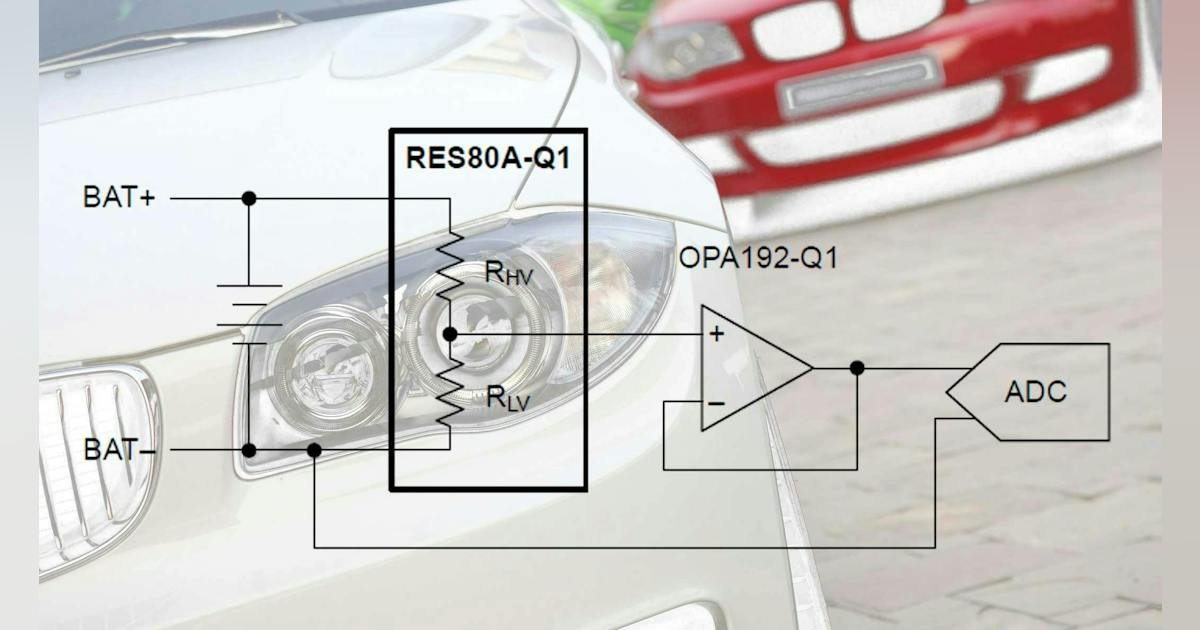
The device, with a nominal high-voltage input resistance of 50 MΩ, is available in several nominal high- to low-resistance ratios (RHV:RLV) to meet a wide array of system needs. Eight ratios span from 145:1 all the way to 1000:1.
Ratio-Matching Precision
With voltage dividers, ratio matching is as important as absolute accuracy. The RES80A-Q1 series features high ratio-matching precision, with the measured ratio of each divider within ±0.1% (maximum) of the nominal value. This precision is maintained over the specified temperature range and despite aging, it has a cumulative drift of only ±0.2% (max).
As a result, the lifetime tolerance of an uncalibrated RES80A-Q1 remains within a ±0.3% (max) envelope. A high-quality silicon-dioxide (SiO2) insulative layer encapsulates the resistors and enables use at extremely high voltages up to 2,000 V DC for sustained operation, or 4,000 V DC for HiPOT testing (60-second rating).
The thin-film analog wafer process used for the RES80A-Q1 has been intrinsically qualified for sustained high-voltage operation through time-dependent dielectric breakdown (TDDB) testing. This testing is performed by stressing dedicated test structures at a constant high AC or DC voltage for a long duration, until the devices wear out and fail by electrical short.
By testing TDDB at multiple voltages, the process lifetime at a given working voltage is determined by extrapolation using the Weibull method. TDDB testing has shown that the two different biasing conditions of unipolar signals and bipolar signals result in differing operational lifetimes for the process.
The RES80A-Q1 is automotive-qualified under AEC-Q200 temperature grade 1, with a specified temperature range from –40 to +125°C. The device comes in an 8-pin DWV SOIC package, with nominal body size of 7.5 × 5.85 mm, and features creepage and clearance distances of at least 8.5 mm between the high- and low-voltage pins (Fig. 3). (Creepage and clearance parameters are critical to its use in high-voltage designs and subsequent regulatory approval.)