Blog
Jae Ko’s Paper Sculptures Explore Color, Form, and Nature

Saturated spirals of blue, green, and magenta curl into intricate forms that resemble everything from tree rings to geological formations. At first glance, Korean-born artist Jae Ko’s sculptures could be made from carved wood, molded clay, or even stone. But the material behind these richly textured works is far more ordinary: paper.
Photography courtesy of Jae Ko
Ko has spent more than four decades exploring the sculptural possibilities of paper, transforming discarded office supplies, recycled kraft paper, and adding machine paper rolls into intricate, often monumental forms. Her latest exhibition, Striated, at 22MUSE Gallery in Antwerp, Belgium, brings together works from a formative period in her practice, alongside a site-specific installation created for the gallery. It also marks Ko’s first solo exhibition in Belgium.

Photography courtesy of Jae Ko
Ko’s process is both methodical and experimental. She begins by unwinding tightly coiled rolls of paper, then reshapes the material through rolling, twisting, folding, stacking, and compression. Some works are soaked in sumi ink, a traditional Japanese calligraphy ink made from soot, while others incorporate pigmented inks that introduce saturated shades of blue, red, green, and violet. Depending on the piece, she may also cut, carve, bind, or even bury the paper, letting time and environmental conditions shape its final form.

Photography courtesy of Jae Ko
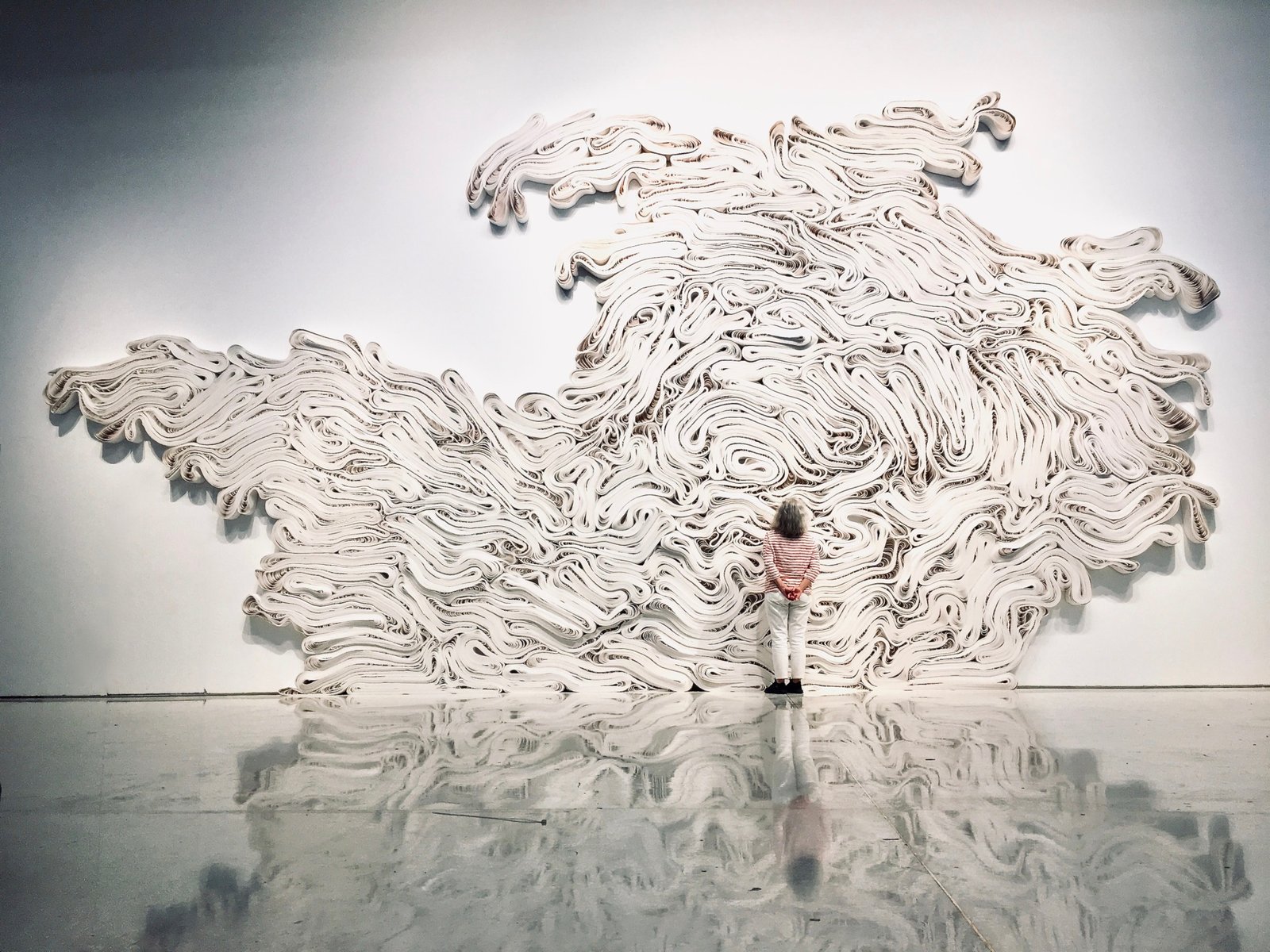
The results are surprisingly varied. Some sculptures curl inward like tightly wound spirals, their layered edges creating rhythmic patterns reminiscent of tree rings or sedimentary rock. Others stretch into elongated ribbons or fold back on themselves, producing forms that appear almost fluid despite their dense construction. The accumulation of countless individual layers gives the sculptures a visual weight that belies the fragility of their source material.

Photography courtesy of Jae Ko
That tension between delicacy and durability is central to Ko’s work. Through repetition and compression, she transforms paper into a material capable of holding substantial volume and complex three-dimensional shapes. The process itself becomes visible in every ridge, groove, and curve.

Photography courtesy of Jae Ko
Nature has long informed Ko’s approach, though her sculptures rarely represent a specific landscape or organism. Instead, they explore the forces that shape the natural world: erosion, growth, accumulation, and movement. Her large-scale installations, constructed from densely packed bundles of paper that loosen as they rise, can evoke rolling hills, ocean tides, or glacial formations. The resulting surfaces seem to shift and flow, even when completely still.

Photography courtesy of Jae Ko
Ko’s relationship with landscape has also evolved geographically. After growing up in Seoul and studying in Japan, she relocated to the United States, eventually settling on Maryland’s Eastern Shore. Her work reflects both the urban environments of her early life and the natural surroundings she encountered later. She has also drawn parallels between her sculptures and bristlecone pine trees in the American West, whose trunks and branches are gradually reshaped by wind and weather.

Photography courtesy of Jae Ko
For Striated, the title itself points to the fine parallel lines and grooves that define much of Ko’s work. The exhibition considers how those accumulated layers function as a record of time and labor, with each fold and compressed edge revealing something about the process of its making.
Striated is on view at 22MUSE Gallery in Antwerp, Belgium, through November 28, 2026.
Editorial Transparency: This article was developed with the assistance of AI tools, which may have been used for research, outlining, editing, or copy refinement. Reporting, fact-checking, and editorial decisions were made by the Design Milk editorial team.