Blog
Tektronix Extends 7 Series from Four to Eight 25-GHz Channels in New Scope

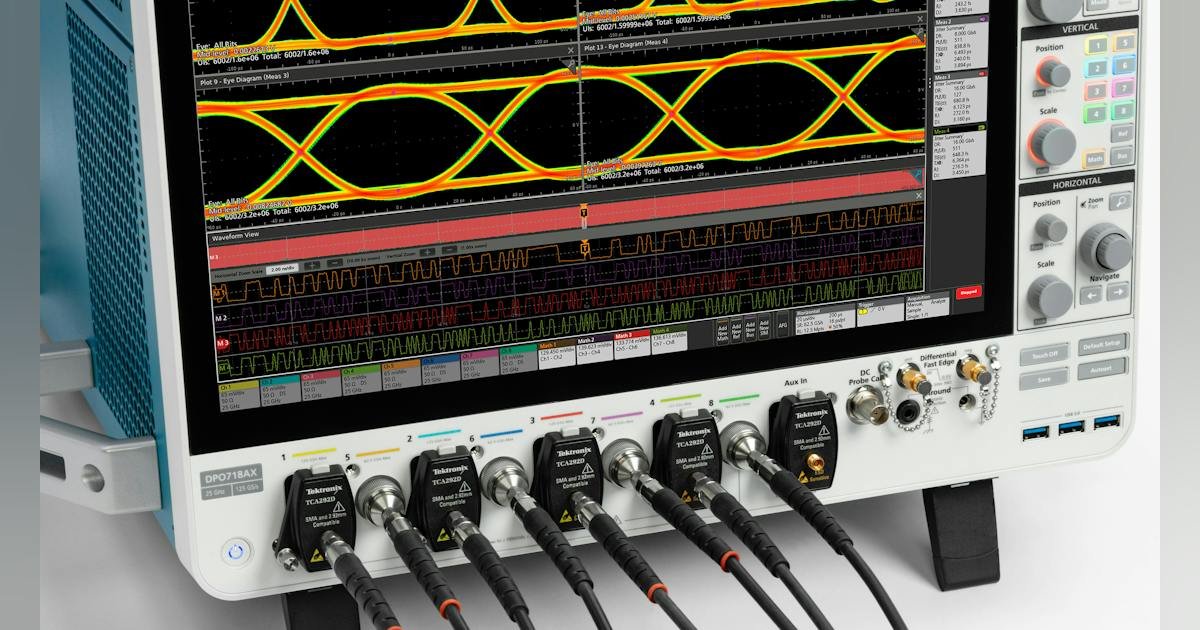
That approach is notable because it extends the machine without turning it into a two-box solution. High-performance oscilloscopes often consume substantial rack space once users add a second instrument, external synchronization hardware, switching infrastructure, and the cable management needed to bring related signals into a common measurement workflow.
According to the company, the DPO718AX consolidates eight synchronized channels in a single 8U configuration, avoiding an increase in rack footprint for teams that might otherwise deploy two instruments.
Of course, front-panel density is only part of the challenge. At 25 GHz, connector interfaces, cable behavior, fixture design, probe selection, signal-path loss, and channel matching all influence what’s ultimately seen by an engineer. A brief tour of the U.S. factory in Beaverton, Ore., revealed the meticulous efforts in measurement and calibration of each instrument and every one of its eight signal channels, taking no shortcuts to ensure fully matched behavior across all eight channels.
Tektronix specifies 12-bit ADC resolution, high effective number of bits (ENOB), and ultra-low random noise for the DPO718AX. Its QuietChannel technology actively compensates for high-speed signal loss, a capability intended to improve measurement fidelity when the signal path itself would otherwise obscure the device-under-test behavior.
Memory and Processing Matter, Too
Bandwidth and channel count receive most of the attention in a product announcement like this one. But sustained usefulness in a system-debug instrument also depends on record length and the ability to move through large datasets without turning analysis into a waiting exercise.
The DPO718AX provides 500 Mpoints of standard record length, expandable to 2 Gpoints, in both four- and eight-channel operation. That’s important for measurements where a brief high-frequency event must be understood in the context of a longer operating cycle. A rare pulse anomaly, for example, may only make sense when viewed alongside a preceding control event, a power transient, or a gradual change in system state.
The scope also includes 96 GB of memory and GPU-assisted processing. For moving large captures to external computing resources, it supports 10-GbE SFP+ LAN and Tektronix’s TekHSI library. The company’s TekScope PC environment can display and compare data from as many as four oscilloscopes on one screen, allowing teams to review results off-instrument and compare multiple systems or test conditions.
Tek’s user interface has been a common platform across all of its high-end scopes. It creates familiar controls and operation for engineers and scientists looking to increase their accuracy, bandwidth, channel count, and/or signal processing capabilities in the lab or field.
The DPO718AX isn’t intended to eliminate all multi-instrument test configurations. Rather, it gives users the option to put more tightly related channels into a single coherent acquisition domain before expanding outward to a broader test system.
Applications Demand Correlation
The new added-channels configuration aligns with several classes of measurement problems where correlation is often as critical as waveform shape.
In photon Doppler velocimetry and other advanced optical measurements, multiple sensors may observe different locations or aspects of an event. Synchronized acquisition helps identify timing differences, spatial variation, signal loss, and propagation effects without relying on separate captures that may not reproduce an event in exactly the same way.
For phased-array RF and radar developers, the instrument’s eight channels can support coherent multi-channel analysis using the SignalVu PC. The software supports spectral, advanced vector-signal, pulse, and radar measurements. In such systems, relationships among paths, including timing, phase, amplitude, pulse characteristics, and modulation behavior, often matter more than any one channel in isolation.
In high-speed digital validation, the ability to capture four differential lanes simultaneously can simplify a test setup while exposing interactions that are inherently system level. Crosstalk, coupled noise, lane-dependent jitter, equalization behavior, and simultaneous switching effects become easier to investigate when the relevant waveforms share one trigger and one acquisition timeline.
The 7 Series also supports multi-signal jitter and eye-diagram analysis for non-return-to-zero (NRZ) and pulse-amplitude-modulation (PAM) signaling, along with signal-integrity modeling intended to de-embed the signal path to the device-under-test (DUT) pin, model actual interconnect behavior, and apply equalization.
Upgrade Path and Availability
For existing 7 Series users, the company plans to offer an upgrade kit to move qualifying instruments to the expanded DPO718AX configuration. That path could be particularly significant for laboratories that adopted the earlier platform for its fidelity and modularity but now face a growing need for simultaneous high-bandwidth capture.
The DPO718AX is available immediately. Several systems were visible on the Tektronix shop floor during a brief site visit this week by Electronic Design. This suggests that the eight-channel configuration is being announced with the instrument in production, rather than remaining future roadmap vaporware.
Tektronix also plans to introduce its P7725 TriMode probe this fall. The probe is designed for the 7 Series and specified for high-speed serial measurements with up to 25 GHz of bandwidth. That addition matters because a high-bandwidth oscilloscope is only as capable as the probe, fixture, cabling, and signal-integrity workflow connected to it.
In the end, the DPO718AX represents a familiar direction for high-end oscilloscopes: more speed, more bandwidth, and more compute. But the more consequential change may be simpler. By putting eight synchronized 25-GHz channels into one instrument, which Tektronix claims as being unprecedented, this new scope gives engineers a better way to look at the intricate details within complex high-bandwidth systems.
For Electronic Design readers’ convenience, we’re appending this PDF of the Tek product brief on the DPO718AX: