Blog
History Lessons from the Future: What a 70-Year-Old Sci-Fi Movie Can Tell Us About the Hazards of AI

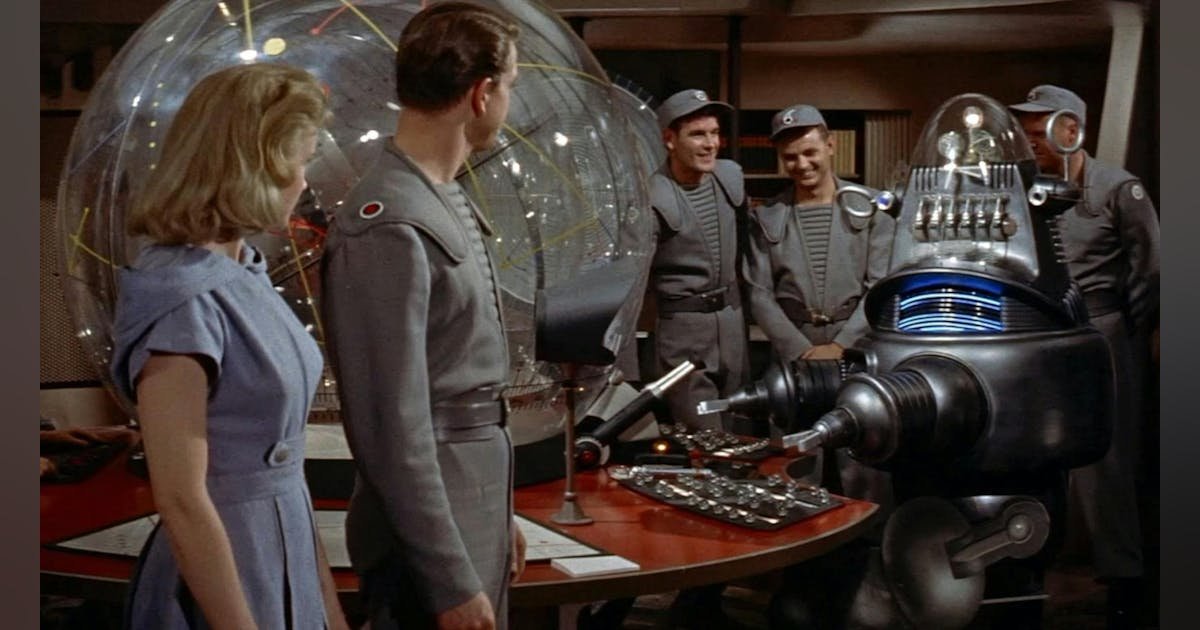
But the movie’s greatest achievement is that it’s the first, and arguably the best, cautionary tale about the potential hazards of AI, many of which are only becoming apparent to most of us seven decades after its release.
Forbidden Planet is set in the 23rd century and opens with the arrival of the United Planets starship C-57D at the distant planet Altair IV (does this sound familiar?). The ship’s crew, who had been sent to learn what happened to a group of explorers who ventured there 20 years earlier, are greeted by only two survivors, the scientist Dr. Edward Morbius and his daughter Altaira. The other members, Morbius explains, had been killed, one by one, by a mysterious, unseen “planetary force” shortly after their arrival.
Since that tragedy, Morbius says that he devoted most of his time to studying what was left of the civilization built by the planet’s original inhabitants, a highly advanced race known as the Krell. Although an unexplained cataclysm wiped out an entire population in a single night 200,000 years earlier, many of the machines they created continue to run, powered by a vast underground network of self-repairing nuclear reactors.
To prove his point, Morbius demonstrates a Krell device that he used on himself to amplify his intellect and brain power. We eventually learn that that the same machine can also turn whatever its user imagines into solid reality. It’s also revealed that Morbius used the device to reform part of the planet’s desolate landscape into a virtual garden of Eden, populated with all kinds of beautiful plants and animals.
Beware the Id Monster
That seeming tranquility is short-lived, however, when an invisible, malevolent presence attacks the starship and murders several crewmen. It’s only then that Morbius confesses he had discovered the machine he used to amplify his brain power also amplified its users’ darker, subconscious impulses.
Like the Krell, Morbius realized too late that the machine manifested these uncontrollable primitive urges in the form of what he refers to as “Monsters from the Id” — powerful creatures made of pure energy that destroyed their own creators.
Back here, on 21st Century Earth, it’s beginning to look a lot like we’ve created our own Id Monsters. You may be scratching your head trying to connect the dots between the fate of the fictional Dr. Morbius and the very real hazards posed by the technologies inhabiting a rapidly growing number of super-sized server farms across the planet. If so, I suggest you take a closer look at how they’re already amplifying the darker, destructive impulses of businesses and governments, without any concern for their potential long-term impact on economies, societies, or the people who inhabit them.
Is It Really “Just a Tool”?
A legitimate argument can be made that “AI is simply a tool” which is used to amplify our intellect for whatever purpose we choose. The same advocates often believe that AI technology is sparking a third industrial revolution that will unleash even greater productivity and wealth than the earlier revolutions based on steam and electricity.
While these claims may be true, few if any of AI’s cheerleaders are interested in discussing exactly who will benefit most from that wealth, or who will be impacted most by its inevitable downsides. Meanwhile, the vast sums of money involved with AI’s development and deployment has muted any meaningful discussion about its harmful effects, or that the technology appears to be evolving much faster than our ability (or interest) to regulate its use.
Many of the problems we’re experiencing with AI are being amplified by the fact that the technology is largely developed and used by large corporations whose primary goals are to maximize profits and move any unnecessary costs off the company’s ledgers. This is becoming increasingly apparent as a growing number of corporations are investing heavily in AI as a tool for downsizing their work forces. They’re using mass surveillance techniques as market tools, distorting markets, and other enshittification tactics.
Warning Tremors
I’ve spent much of my career reporting on the rapid changes triggered by the rise of the internet in the 1990s. But I’ve been surprised at how quickly a significant fraction of the world’s economy has been hijacked by Google/Alphabet, Anthropic, Palantir, and other AI service providers to fuel a multi-trillion-dollar AI arms race for dominance.
The most obvious casualties of this war are the residents of the towns, cities, and counties where these companies are frequently using their vast resources to dodge zoning and environmental regulations as they build noisy, thirsty, power-hungry data centers that provide few permanent jobs or any other benefits for local residents.
We’re already experiencing warning tremors of the upcoming disruption as companies invest billions in AI services, which allows them to cut head counts and de-skill as many of the remaining jobs as possible. Unlike earlier technical revolutions, it’s unclear if any more than a small fraction of the lost jobs will eventually be replaced with different types of skilled positions or other opportunities.
We’re also seeing a growing number of companies deploying AI-based technologies against their own customers with “demand pricing” and other surveillance-based tools to monitor and manipulate their preferences and consumption habits.
Speaking of surveillance, governments and corporate entities can now take their pick from a bumper crop of cheap, powerful, and widely available software suites. These can be used to extract “suspicious behavior” from wide swaths of audio, video, and data streams, and identify the individuals attached to them. In most cases, there are few if any legal constraints to protect us from the growing number of well-documented incidents of misuse.
It’s Déjà vu All Over Again
Humanity’s struggle to balance the benefits and costs of technology isn’t new. Our history includes many accounts of the unwanted side effects of unregulated industries dating back to at least the early 1800s, when cities began to choke on their own coal smog, sewage, and waste and generations of factory workers toiled struggled under conditions that approached slavery.
It took nearly a century for a combination of market forces, advances in technology, and regulations, such as the United Kingdom’s Clean Air Act of 1956, as well as labor rights laws, to slowly bring the calamities under control.
At the dawn of our third Industrial Revolution, I worry AI is spreading so rapidly that its hidden downsides could hit us much sooner than we realize. And it will come far sooner than we will be able to agree on their origin or what we need to do to manage the economic, social, and environmental consequences.
As a member of the tech and engineering community, do you believe the prosperity and opportunities created by our third industrial revolution will outweigh the problems I’ve described? If not, do you have any ideas about what we must do to avoid suffering a very real version of the fate of the imaginary aliens in Forbidden Planet?
Please share your thoughts in the comments section below and register your opinion in the poll associated with this op-ed. You are also welcome to email me with your comments by clicking here.