Blog
Middle East crisis live: Trump rejects Iran response to US peace proposal as Tehran warns of new attacks | US-Israel war on Iran

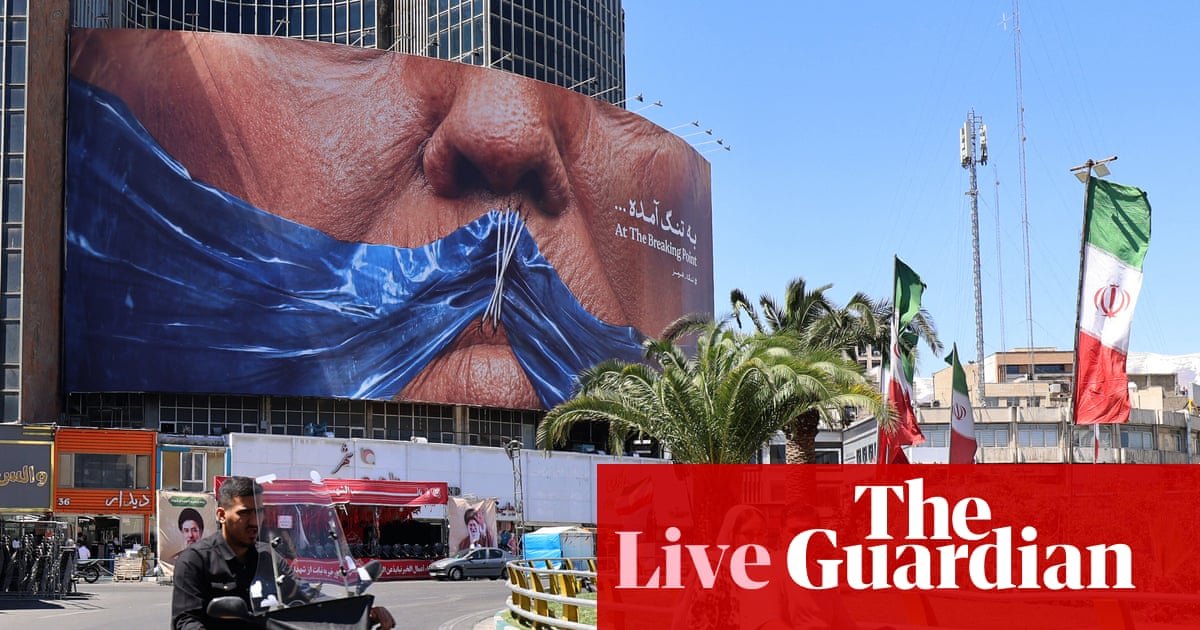
Trump rejects Iran response to US peace proposal as Tehran warns it is prepared to retaliate against US strikes
We are restarting our live coverage of the US-Israeli war on Iran after Donald Trump described Tehran’s response to Washington’s peace proposal as “totally unacceptable”, raising the possibility of fresh conflict.
Iran warned it would not hold back from retaliating against any new US strikes or permit more foreign warships in the strait of Hormuz.
A ceasefire meant to facilitate peace talks came into effect in Apri. It has been largely observed, despite exchanges of fire and reports of strikes in the strategic strait of Hormuz, which Iran has continued to effectively block in response to being attacked by the US and Israel in February.
The US military in turn has blockaded Iranian ports since 13 April, claiming it has turned back 61 commercial vessels and disabled four.
According to Iranian state media, Tehran’s proposal included demands that the US lift its sanctions, end its naval blockade and called for an immediate end to the war with guarantees against any renewed attack on the country.
Posting on Truth Social, Trump said: “I have just read the response from Iran’s so-called ‘representatives’. I don’t like it – totally unacceptable.”
The US had presented a peace proposal a week ago, which, as my colleague Julian Borger notes here, was reported to consist of a one-page, 14-point memorandum of understanding that would reopen the strait while setting a framework for further talks on Iran’s nuclear programme.
Trump told US outlet Axios he’d discussed the Iranian response in a phone call with his close ally, Israeli prime minister Benjamin Netanyahu. “It was a very nice call. We have a good relationship,” he said, before stressing that the Iran negotiations are “my situation, not everybody else’s.”
Netanyahu warned the war would continue as long as Iran had a stockpile of highly enriched uranium (HEU), which could be used to make nuclear warheads.
Key events
Despite these attacks, Lebanese president, Joseph Aoun, is engaging in diplomatic efforts to bring an end to the Israeli war on his country.
The two countries have formally been in a state of war since the founding of the state of Israel in 1948. They held their first diplomatic talks in over three decades last month.
Ahead of the third round of talks scheduled between representatives from Israel and Lebanon on 14 May and 15 in Washington, Aoun stressed the need to urge Israel to stop its ceasefire violations and demolition of homes in a conversation with the US ambassador to Lebanon, Michel Issa, according to Lebanon’s national news agency.
Hezbollah has rejected the premise of direct talks with Israel, seeing them as a capitulation.
Hezbollah started firing at Israel shortly after the US and Israel launched its war on Iran by killing the country’s former supreme leader on 28 February. Israel responded with airstrikes and launched a ground invasion of southern Lebanon.
The Israeli military now occupies a strip of Lebanese land along the border. Officials claim they want to create a ‘security zone’ to protect Israel’s northern communities from Hezbollah attacks. But this has stoked fears of a long-term occupation.
Sweeping evacuation orders have forced hundreds of thousands of Lebanese people to flee and many fear they won’t be able to return as homes are demolished and Israeli attacks across southern Lebanon continue without any rebuke from the US, which brokered the ceasefire agreement between the Lebanese government and Israel last month.
Israel is pushing for the disarmament of Hezbollah, something the militant group has rejected. Hezbollah, which is not part of the Lebanese government’s security apparatus, has been targeting Israeli troops in Lebanon.
It said it will not cease its attacks on Israeli troops inside Lebanon and on towns in northern Israel as long as Israel continued its ceasefire violations. Under the agreement’s terms, Israel retains a “right to take all necessary measures in self-defence, at any time, against planned, imminent, or ongoing attacks”.
Reports of more deadly Israeli attacks on Lebanon despite ceasefire
Two people were killed and five others injured in an Israeli airstrike on the southern Lebanese town of Abba this morning, according to Lebanon’s state-run national news agency (NNA), which has reported muttiple Israeli attacks across the country today.
The NNA also reported that Israeli warplanes launched a series of airstrikes this morning on the towns of Yahmar al-Shaqif and Kfar Tebnit, and shellilng on the towns of Yahmar Arnoun, Nabatieh al-Fawqa and Mayfadoun.
Despite a US brokered ceasefire agreement, Israel and Hezbollah have continued with their attacks, accusing each other of violations.
Israel has been accused of violating the ceasefire agreement many times, with strikes killing civilians and homes continuing to be demolished despite the military claiming it is only targeting Hezbollah sites.
Hezbollah, the Iranian backed Lebanese militant group, reportedly said earlier that its fighters had targeted an Israeli military position in the village of Taybeh along the Israel-Lebanon border, forcing its troops to retreat.
Iranian authorities on Monday hanged a postgraduate student from a university in Tehran on charges of espionage. Erfan Shakourzadeh, 29, was hanged after being convicted for collaborating with the CIA and the Mossad, the Iranian judiciary’s Mizan Online website said.
Norway-based rights groups Iran Human Rights and Hengaw said that Shakourzadeh was a student at Tehran’s prestigious Iran University of Science and Technology and had written a message before his execution rejecting the charges as fabricated.
Describing him as an “elite student”, IHR said he was held “in solitary confinement and subjected to torture and forced to give false confessions”. He is the fifth person to be executed on espionage charges since the beginning of the US-Israeli war on Iran in late February.
The UK and France will host a multinational meeting of defence ministers involving 40 countries tomorrow to discuss military plans to restore trade flows through the strait of Hormuz, the British defence ministry said.
The UK’s defence secretary John Healey and his French counterpart Catherine Vautrin will co-chair the meeting. Healey said:
When I co-chair this meeting of nations from around the world, our job will be to make sure we are not just talking, we are ready to act.
That is why I have directed HMS Dragon to the Middle East, so Britain is in position to support this mission the moment it is needed.
This government will not stand by when instability drives up costs for British families and businesses.
The UK has already announced the deployment of HMS Dragon to the region so the destroyer can play a role in a multinational mission should the conditions allow after the US-Israel war on Iran is over.
Iran on Sunday threatened to strike British and French warships in the strait if they try to help reopen the strategic waterway.
French President Emmanuel Macron subsequently clarified that France had “never envisaged” a naval deployment but rather a security mission that would be done in coordination with Tehran.
South Korea condemns attack on cargo ship in strait of Hormuz
South Korea has condemned an attack against a cargo ship operated by a Korean shipper on 4 May in the strait of Hormuz and said it plans to respond once the source of the attack is identified.
Namu, the vessel operated by the shipper HMM Co., was not in violation of any rules in effect at the time in the waters off the UAE and it was a case of an attack against a commercial vessel that cannot be justified, the official said.
“We condemn this in the strongest terms,” Wi Sung-lac, the South Korean presidential national security adviser, told reporters.
“We’ll seek through further investigation to identify the party responsible for the attack, the exact type of projectile and its physical size.”
South Korea’s defence minister Ahn Gyu-back is due in Washington for talks with the US defence secretary Pete Hegseth on Monday.
They could possibly discuss cooperation to restore freedom of navigation through the strait of Hormuz with its effective closure raising concerns about a looming energy crisis in South Korea’s trade-dependent economy. Washington has urged its allies to help unblock the strait but has so far been met with a wall of resistance.
In response to US-Israeli attacks, Iran has effectively closed the strait to most traffic, inflicting severe economic damage around the world as the waterway usually carries about 20% of global oil shipments and significant amounts of gas and products including fertiliser.
Al Jazeera is carrying some comments from the Iranian foreign ministry spokesperson Esmail Baghaei, who is speaking about the Iranian proposal to end the war that the US has emphatically rejected.
“Demanding an end to the war, lifting the (US) blockade and piracy, and releasing Iranian assets that have been unjustly frozen in banks due to US pressure,” Baghaei was quoted as having said.
“Safe passage through the strait of Hormuz and establishing security in the region and Lebanon were other demands of Iran, which are considered a generous and responsible offer for regional security,” he added.
“Whenever we are forced to fight, we will fight, and whenever there is room for diplomacy, we will seize that opportunity,” Baghaei was also quoted as having told a news briefing earlier.
He said the US’s demands were “unreasonable” and suggested that stability in the region had been undermined by Trump’s rejection of Iran’s response to Washington’s peace proposal.

Julian Borger
The US parameters for nuclear talks reportedly included a moratorium on Iranian nuclear enrichment for up to 20 years; the transfer overseas, possibly to the US, of Iran’s stockpile of highly enriched uranium (HEU), which could be used to make nuclear warheads; and the dismantling of Iranian nuclear facilities.
According to the Wall Street Journal, the Iranian counter-proposal suggested a shorter moratorium, the export of part of the HEU stockpile and the dilution of the rest, and refusal to accept the dismantling of facilities.
The Israeli prime minister, Benjamin Netanyahu, had earlier warned the war would continue as long as Iran had a stockpile of HEU.
“It’s not over, because there’s still nuclear material – enriched uranium – that has to be taken out of Iran. There’s still enrichment sites that have to be dismantled,” he told the CBS programme 60 Minutes, according an excerpt published before its broadcast.
Asked how the HEU should be removed, Netanyahu said: “You go in and you take it out,” adding that the best way would be to enter Iran to secure the fissile material as part of an agreement. He said Donald Trump had told him he wants “to go in there”.
In a separate interview, Trump appeared to take a more relaxed view of the HEU stockpile, which the UN nuclear watchdog, the IAEA, says is buried deep under mountains in central Iran. The US president suggested that for the time being, satellite surveillance was sufficient to guarantee no one had access to it.
Trump rejects Iran response to US peace proposal as Tehran warns it is prepared to retaliate against US strikes
We are restarting our live coverage of the US-Israeli war on Iran after Donald Trump described Tehran’s response to Washington’s peace proposal as “totally unacceptable”, raising the possibility of fresh conflict.
Iran warned it would not hold back from retaliating against any new US strikes or permit more foreign warships in the strait of Hormuz.
A ceasefire meant to facilitate peace talks came into effect in Apri. It has been largely observed, despite exchanges of fire and reports of strikes in the strategic strait of Hormuz, which Iran has continued to effectively block in response to being attacked by the US and Israel in February.
The US military in turn has blockaded Iranian ports since 13 April, claiming it has turned back 61 commercial vessels and disabled four.
According to Iranian state media, Tehran’s proposal included demands that the US lift its sanctions, end its naval blockade and called for an immediate end to the war with guarantees against any renewed attack on the country.
Posting on Truth Social, Trump said: “I have just read the response from Iran’s so-called ‘representatives’. I don’t like it – totally unacceptable.”
The US had presented a peace proposal a week ago, which, as my colleague Julian Borger notes here, was reported to consist of a one-page, 14-point memorandum of understanding that would reopen the strait while setting a framework for further talks on Iran’s nuclear programme.
Trump told US outlet Axios he’d discussed the Iranian response in a phone call with his close ally, Israeli prime minister Benjamin Netanyahu. “It was a very nice call. We have a good relationship,” he said, before stressing that the Iran negotiations are “my situation, not everybody else’s.”
Netanyahu warned the war would continue as long as Iran had a stockpile of highly enriched uranium (HEU), which could be used to make nuclear warheads.