Blog
Sensors Converge ‘26: smart glasses, robots, Edge AI predictions

Sensors Converge 2026 once again tackled the big trends and challenges in Edge AI and sensors-related applications. One keynote speaker from TDK Invensense on Wednesday offered a prediction for when smart glasses will eventually reach maturity— but it was not soon enough for smart glasses groupies.
Also on Wednesday, a Qualcomm executive described to the surprise of his audience that the company has begun moving into industrial applications, including AI inferencing om edge gateways used in oil fields in the Middle East.
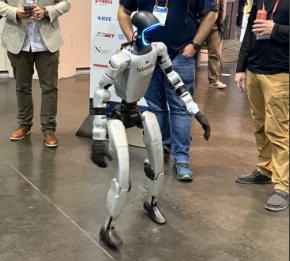
The exhibition floor opened Wednesday, welcoming thousands of attendees to see more than 160 exhibits. Some of the biggest crowds immediately surrounded a robotic dog and a humanoid robot at the Toborlife booth near the entrance.
An EDGE AI FOUNDATION pavilion of several smaller companies was busy with potential customers.
The smart glasses rap
“Why aren’t we wearing smart glasses today?” asked Omar Abed, CTO of TDK Invensense in a keynote address. He ticked off a list of concerns: too bulky, too expensive at $1,000 for many models, lacking in style despite being around for more than decade, connected to a limited number of apps.
He offered a number of ways changes to emerging sensors can help: by lowering their weight and the overall weight of the glasses and by reducing the power the sensors consume to improve smart glass battery life.
Sensors in smart glasses consume 7% of total system power and 40% of the indirect and direct weight. Some smart glasses running virtual reality will only have enough battery life for less than an hour, he noted.
TDK Invensense is providing a series of sensors that can be used in more than eight elements of smart glasses, everything from gesture detection to activity tracking. Invensense makes low power sensors such as a MEMS IMU, a TMR sensor, a digital microphone and an ultrasonic time-of-flight sensor.
The company is also working on keeping some AI functions analog instead of digital, which Abed said has “drastically reduced power consumption.”
The big takeaway Abed left with the keynote crowd was his pronouncement, based on Gartner data, that Edge AI (supporting smart glasses and other devices) is at a “turning point” in 2026, which is also what Gartner calls the “trough of disillusionment” for emerging tech. In 2028 and successive years, edge will have reached “maturity and standardization,” he added, which didn’t surprise several attendees but left them somewhat concerned.
Edge or Extinction
The Edge AI theme was picked up in another keynote address by EDGE AI
FOUNDATION CEO Pete Bernard who titled his address, “How Edge AI will save the world.” He joked he was tempted to exaggerate even more with another title, “Edge or Extinction.”
The foundation is a nonprofit tasked with educating developers and the public about the advantages of edge AI tech. On Wednesday, Bernard announced an Edge AI Advanced Sensing Certification to accompany a number of other certifications. Enrollment is available online.
Bernard also cited Gartner in predicting generous growth in edge AI, growing from nearly $12 billion in value in 2025 to $56 billion in 2030.
Growth will come partly with creation of smaller AI models with higher quality. “We can invent new architectures that are way more efficient,” he added.
One promising concept on the road ahead is neuromorphic spiking which will eliminate the bus between memory and computer, with in-memory compute.
Even so, he warned, “there’s not a linear path forward” for Edge AI. AI is early in its adoption curve.
“We’re in the steam era of AI and we are shoveling coal into these [applications] and it’s brute force as big iron moves down the tracks. It’s early, super early.”
Qualcomm in the oil biz
Qualcomm’s Kapil Kamra described in a Live Stage interview with Fierce how the chip design company is moving into industrial applications, while also holding onto its traditional consumer offerings.
The director of product management for Qualcomm described how Saudi Arabian oil giant Aramco is deploying an industrial intelligent gateway platform that relies on edge AI inferencing for detecting impurities in oil products. He said the company saves dollars on the edge inferencing by limiting cloud connections that would be expensive and time consuming. The work was described by Qualcomm in February but the Sensors Converge crowd indicated they didn’t know about it. Asked if any of them knew Qualcomm was active in the industrial space in this way, nobody raised a hand.
Quantum wafers in San Jose
A big surprise to me was meeting and interviewing the CEO and also the CTO of Pure Wafer, based in San Jose. The company is the largest US-based supplier of virgin silicon wavers and specialty thin products. It offers reclamation services and even fabricates quantum wafers in a San Jose fab, said CEO S. Mark Borowicz and CTO Ardy Sidhwa.